
Quick Summary
This blog will show you, step by step, how your business can integrate an AI support chatbot into your customer support process. The blog covers the steps of chatbot integration, including analysis of the current support system, automation of repetitive tasks, and integration of the chatbot with CRM and helpdesk tools.
With an AI support chatbot, a business can deliver 24/7 support, reduce time spent on manual support, respond faster to customers, and increase support outputs without increasing staff size. This guide provides numerous examples of AI chatbot automation processes and successful implementations.
Table of Content
- Introduction
- Why Businesses Are Using AI Customer Service Chatbots
- What is an AI Customer Service Chatbot?
- When You Should Integrate an AI Support Chatbot
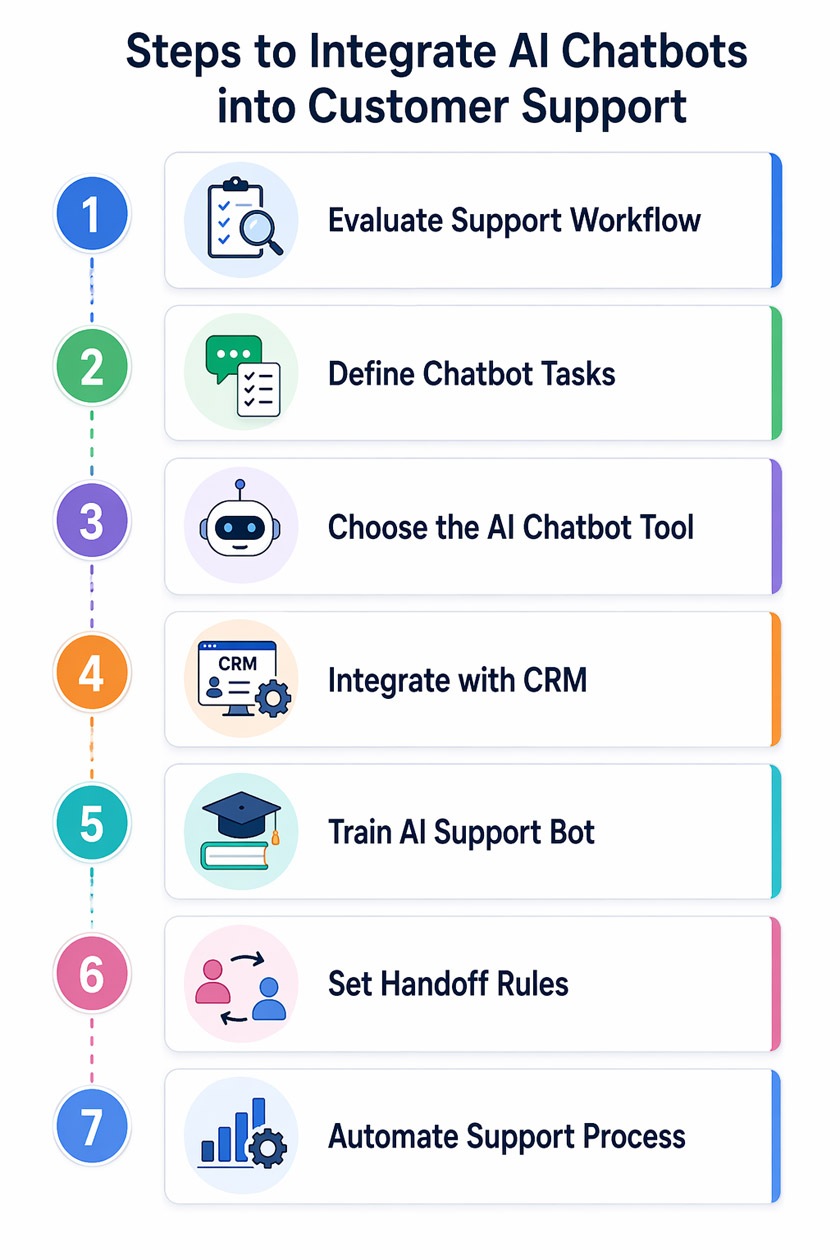
- Step-by-Step Guide to Integrate AI Chatbots into Customer Support Workflow

- Evaluate the Current Support Process
- Define What You Want the Chatbot to Do
- Choose the Right AI Customer Service Chatbot Platform
- Integrate Chatbot with Helpdesk and CRM
- Train the AI Support Chatbot
- Set Up Human Handoff Rules
- Automate Repetitive Support Tasks
- Test the Workflow Before Launch
- Monitor Performance and Improve
- Best Use Cases of AI Customer Service Chatbots in Support Workflow
- Real Example: How Glorywebs Implemented an AI Customer Service Chatbot for Faster Support
- Common Mistakes to Avoid When Integrating Chatbots
- The Future of Customer Support with AI Chatbots
- Conclusion
- FAQs: AI customer service chatbot
Introduction
The level of customer expectations increases as technology evolves. Customers now expect prompt responses, 24/7 access to customer service representatives, answers tailored to their needs, and assistance from a personalized service representative. If your business cannot keep up with immediate demands, you may lose out on potential leads and customers. For these reasons, many businesses are using AI chatbots to assist with customer support, reduce the demand placed on employees, and provide faster resolution times.
Chatbots built with artificial intelligence can respond to customer inquiries, qualify leads, create support tickets, and assist customers throughout the help-seeking process without requiring a human representative. When correctly deployed, an AI customer service chatbot becomes a complementary tool to a company’s customer care department.
In this guide on chatbots, you will be taken through all of the steps required to deploy a bot and show you other ways you can utilize chatbots as part of your company’s customer experience enhancement efforts.
Why Businesses Are Using AI Customer Service Chatbots
Customer support representatives are answering the same questions each day. If you want to employ additional customer support representatives, then your costs will increase. In the meantime, if you respond slowly to customers, their level of satisfaction will drop. The AI customer service chatbot will enable your customer support representatives to respond quickly by automating answers to frequently asked questions.
Advantages of utilizing Support Workflow Automation:
- Support is available to customers at any time
- Instant response for frequently asked questions
- Less work for customer support representatives
- Faster resolution of tickets
- Improved experience for customers
- Reduced operating costs
A customer service representative can assist with more difficult issues using an AI support chatbot; your representatives will be able to assist the customer with their inquiry by utilizing hundreds of AI support platforms to respond to common inquiries.
What is an AI Customer Service Chatbot?
An AI customer service bot is an intelligent piece of software that communicates with customers using natural language. It can understand questions, provide answers, collect data, and route conversations to the correct department.
Modern AI bots have features that go beyond simple conversational capabilities. For example, the following features have enhanced how a bot will serve customers:
- Natural Language Processing (NLP)
- Machine Learning
- Automated workflows
- CRM integration
- Helpdesk integration
As a result, an AI customer service bot can help you build your customer service ecosystem.
When You Should Integrate an AI Support Chatbot
While not all businesses start with automation, there are specific indicators that indicate the need for it.
There are several reasons to integrate an AI customer service chatbot:
- Your team receives too many repetitive queries
- Customers complain about slow replies
- Support costs are increasing
- You need 24/7 availability
- You want to automate lead capture
- Your agents are overloaded
Implementing an AI support chatbot can help your company expand its customer support without hiring additional personnel.
Step-by-Step Guide to Integrate AI Chatbots into Customer Support Workflow
Integrating an AI customer service chatbot into your support workflow is not just about adding a chat widget to your website. It requires proper planning, the right tools, and a clear understanding of how your current support system works. When implemented correctly, an AI support chatbot can automate repetitive tasks, improve response time, and help your team handle more customer queries without increasing workload.
Below you’ll find the step-by-step process for successfully integrating AI-assisted Chatbot technology into your customer support workflow.
Evaluate the Current Support Process
Before implementing a chatbot, assess the current support processes being used.
Consider:
- Where clients reach out to your company.
- The most frequently asked questions.
- How tickets are generated.
- How agents communicate with customers.
- Any repetitive tasks.
Once you complete this, you will have a better understanding of where to place the AI customer service bot.
Define What You Want the Chatbot to Do
Not all chatbots serve all purposes. Establish clear goals before implementing them.
Examples of tasks frequently handled by chatbots:
- Answering suggested questions (FAQs)
- Collecting client information
- Generation of support tickets
- Routing chats to agents
- Providing order status to clients
- Scheduling phone calls with clients
- Generating leads
Establishing your goals clearly will also aid in a more straightforward and effective integration with an AI support chatbot.
Choose the Right AI Customer Service Chatbot Platform
It’s important that your chatbot can integrate with other tools you already use.
Make sure to look for these features:
- Customer Relationship Management (CRM)
- Help Desk
- Live Chat Transfer
- Artificial Intelligence (AI) Training
- Workflow Automation
- Analytics
- Multiple Channel Support
The right AI customer service chatbot should work alongside your current support system, not replace it entirely.
Integrate Chatbot with Helpdesk and CRM
Connecting the Chatbot to your workflow will help integrate it into your daily tools.
Some of the integrations possible include:
- Zendesk
- HubSpot
- Salesforce
- Freshdesk
- Intercom
- Slack
- Email systems
With integration, the AI support chatbot can:
- Automatically create Tickets
- Automatically update Customer Records.
- Assign Conversations.
- Notify Agents.
This is where automation becomes powerful.
Train the AI Support Chatbot
AI chatbots improve with training.
Provide:
- Information related to FAQs
- Knowledge base articles
- Records of past support interactions
- Information regarding the relevant product
- Company Policies
- Scripts for Q/A
An AI-trained customer service chatbot provides information with higher accuracy and reduces the burden on your agents.
Set Up Human Handoff Rules
Not all customer service-related issues can be handled by a chatbot.
Criteria to use for transferring to a human:
- Complex Questions
- Upset Customers
- Refund Requests
- Technical Issues
- VIP Customers
A good AI support chatbot understands when to provide assistance and when to transfer to human support.
Automate Repetitive Support Tasks
The major advantage of chatbots is their ability to automate the process.
Some examples of automated processes include:
- Answering Frequently Asked Questions
- Creating Tickets
- Booking Appointments
- Qualifying Leads
- Tracking Orders
- Updating Statuses
- Following-up
Having an AI Customer Service Chatbot automates many of your manual support functions and delivers faster service for your customers.
Test the Workflow Before Launch
Always test before going live.
Test for:
- Chat Accuracy
- Integration Errors
- Ticket Creation
- Agent Routing
- Notifications
- Response Quality
Testing ensures that your AI Customer Service Chatbot operates seamlessly within your workflow.
Monitor Performance and Improve
Once you have integrated the AI Customer Service Chatbots, you should begin measuring the performance.
Key Performance Indicators Include:
- Response Time
- Ticket Resolution Time
- Customer Satisfaction
- Chatbot Accuracy
- Agent Workload
- Conversion Rate
Improving the AI customer service chatbot over time gives better results.
Want faster responses without hiring more agents?
An AI support chatbot helps you provide instant, 24/7 customer support. Try AI Chatbot Today
Best Use Cases of AI Customer Service Chatbots in Support Workflow
Businesses use chatbots for many support tasks.
Common examples include:
- Automation of live chat on websites
- Automation of support tickets
- Chatbots for capturing leads
- Bots designed to support e-commerce
- Chatbots that automate SaaS support
- Bots that allow users to book appointments
- Chatbots that respond to frequently asked questions (FAQs)
- AI-supported bots for mobile apps
Utilizing AI chatbots to enhance customer support workflows improves speed and scalability.
Real Example: How Glorywebs Implemented an AI Customer Service Chatbot for Faster Support
Glorywebs provides an AI chat support bot (technically referred to as a Virtual Support Agent) to help its clients enhance their customer service experience by delivering faster responses to customer inquiries. One such organization that has improved its customer service by utilizing a Glorywebs Virtual Support Agent is MediNova Clinics. This medical clinic organization operates clinics throughout the U.S., and due to its rapid growth, the MediNova support team was experiencing an increased volume of patient inquiries via email and by phone, and was spending a significant amount of time on each inquiry due to staffing constraints. The staff needed an additional way to obtain immediate responses to their inquiries without having to continue adding staff to handle the increased number of patient inquiries.
To achieve this objective, Glorywebs created, developed, and implemented a Virtual Support Agent that would integrate with MediNova’s existing website, patient portal, and communication systems.
The Virtual Support Agent was designed to automate many of the “routine” support tasks associated with MediNova’s customer service operations. Routine support tasks include:
- Appointment scheduling and rescheduling
- Answering common patient questions
- Lab report status updates
- Billing and insurance queries
- New patient onboarding
- Routing complex cases to staff
- Providing 24/7 automated support
As a result of the implementation of the Virtual Support Agent, MediNova Clinics saw the following improvements:
- 60% reduction in their administrative workload
- 300% increase in response time
- 45% reduction in the total cost of operations
- 24/7 access to automated support
- Increased patient engagement
This case study provides clear evidence that implementing an appropriate Virtual Support Agent can significantly improve an organization’s customer support operations and enable a business to grow faster without increasing the resources required to support its customer base.
Common Mistakes to Avoid When Integrating Chatbots
Errors to avoid
- All-on-at-once Automation
- Chat Bot Mislearning
- No support from Human
- CRM & Help Desk Not Included
- Unusable Flow of Conversation
- Failing to Track Any Data Analytics
A well-set-up Artificial Intelligence Customer Service Chatbot should be somewhat helpful but not mechanical.
The Future of Customer Support with AI Chatbots
Artificial Intelligence is transforming the way businesses provide support. Companies that adopt automated systems early will benefit from this shift in customer service.
- Future developments in this area will include:
- Support Bots That Use Voice Technology
- Support For Contact Centers Using Agents That Have Memory
- Predictive Assistance or Future Support
- Fully Automated Workflows
- Personalized Experiences Created By Artificial Intelligence
Most of the customer interactions will soon be handled by an advanced AI support bot.
Conclusion
By adding an AI-powered support robot (chatbot) to your customer service team, companies can provide faster responses to customers, reduce manual tasks for staff, and deliver superior customer service. Once properly set up, an AI-powered support robot (chatbot) can automate repeatable tasks, help customers 24/7, and integrate with your current CRM and helpdesk solutions.
Adding AI to your customer support processes can lead to greater efficiency, lower operating costs, and the ability to expand your services without adding more staff. Companies adopting an AI-powered support robot (chatbot) today will be equipped to handle increasing customer demands in the future.
FAQs: AI customer service chatbot
An AI customer service chatbot is an intelligent software tool that automatically interacts with customers. It can answer questions, create support tickets, route conversations, and provide 24/7 assistance without human intervention.
An AI support chatbot improves workflow by automating repetitive tasks such as answering FAQs, collecting customer information, creating tickets, and routing queries to the right department. This reduces workload for agents and speeds up response time.
Yes, a modern AI customer service chatbot can integrate with CRM, helpdesk, email, and live chat tools like HubSpot, Salesforce, Zendesk, Freshdesk, and others. Integration allows automatic ticket creation, customer data updates, and better workflow automation.
No, integrating an AI support chatbot is not difficult when done with the right platform and strategy. Most chatbot solutions support easy integration with websites, apps, and support tools. Proper planning and training make the process smooth.
An AI customer service chatbot can automate:
- Answering common questions
- Booking appointments
- Creating support tickets
- Lead capture
- Order tracking
- Customer onboarding
- Follow-ups
- Routing chats to agents
This helps businesses handle more customer queries without increasing staff.
Yes, an AI support chatbot is useful for both small and large businesses. Small businesses can use chatbots to provide 24/7 support without hiring extra staff, while large businesses use them to manage high volumes of customer inquiries.
Businesses use an AI customer service chatbot to:
- Reduce support costs
- Improve response time
- Provide 24/7 support
- Automate repetitive work
- Increase customer satisfaction
- Scale support easily
This makes chatbots an essential part of modern customer support workflows.






Comments